
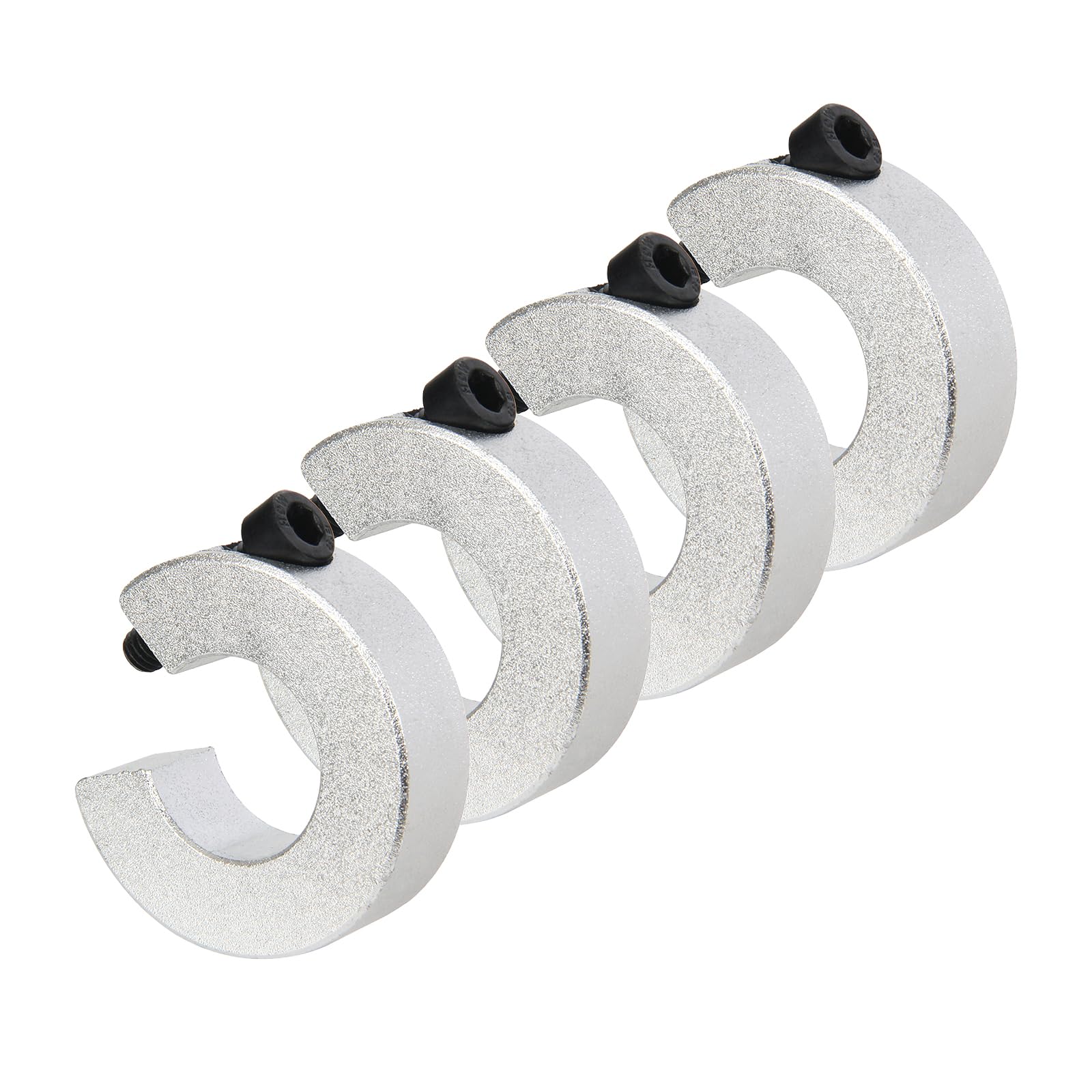
Shaft collars, also known as shaft clamps or locking collars, are simple yet essential mechanical components used to position, locate, and secure parts on a shaft. Despite their simple structure, shaft collars play a critical role in many industrial and mechanical systems.
This article outlines common shaft collar applications and explains when and why they are used in different scenarios.
1. Axial Positioning and Component Location
One of the most common uses of a shaft collar is to provide precise axial positioning on a shaft. Shaft collars are often installed to:
- Prevent axial movement of bearings, pulleys, or gears
- Maintain fixed spacing between components
- Act as mechanical stops along the shaft
In these applications, shaft collars replace more complex machining solutions such as grooves or shoulders, offering flexibility and ease of adjustment.
2. End Stops and Travel Limitation
Shaft collars are frequently used as end stops to limit linear or rotational travel. Typical applications include:
- Linear motion systems
- Lead screws and guide shafts
- Automation and positioning equipment
When installed correctly, shaft collars provide a reliable and repeatable stopping point without damaging the shaft surface.
3. Bearing and Spacer Applications
Shaft collars can serve as spacers or bearing retainers in assemblies where axial location is required but machining tolerances are limited.
- Retaining bearings on smooth shafts
- Maintaining spacing between rotating elements
- Supporting light axial loads
Compared to custom spacers, shaft collars allow easier installation and repositioning during assembly or maintenance.
4. Temporary Positioning During Assembly or Adjustment
During equipment setup, testing, or alignment, shaft collars are often used as temporary positioning tools.
- Initial alignment during machine assembly
- Temporary stops during calibration
- Adjustment reference points
Their reusability makes them especially useful in prototyping and testing environments.
5. Clamp-On vs Set Screw Shaft Collars
Different shaft collar designs are suited for different applications:
- Clamp-on shaft collars provide uniform clamping force, better concentricity, and minimal shaft damage.
- Set screw shaft collars offer a compact and cost-effective solution for applications where shaft marking is acceptable.
The selection depends on load requirements, shaft material, and installation conditions.
6. Typical Industries Using Shaft Collars
Shaft collars are widely used across many industries, including:
- Automation and robotics
- Packaging machinery
- Conveying systems
- Machine tools
- Material handling equipment
7. Load Considerations
While shaft collars are effective for positioning and light axial loads, they are not designed to replace structural load-bearing components.
Factors to consider include:
- Axial load magnitude
- Shaft surface condition
- Installation torque
- Operating vibration
Conclusion
Shaft collars provide a simple, flexible, and cost-effective solution for axial positioning, spacing, and motion limitation in mechanical systems. Proper selection and installation ensure reliable performance and long-term stability.
If you are unsure which shaft collar design best fits your application, consulting technical support before placing an order can help ensure correct selection.
Need assistance with shaft collar selection?
Contact our technical team at support@sinoaxisspace.com